As 2025 draws to a close, we sat down with Kelly Hanna, Ticketer Chief Executive Officer, to reflect on a transformative year — one shaped by the collaboration, honesty and partnership of the operators and authorities we serve.
In this Q&A, Kelly shares the achievements that mattered most, the innovations driven directly by customer feedback, and what Ticketer is focusing on as we move into 2026.
2025’s Biggest Achievement’s & Innovations
Q: Looking back at 2025, what do you think stands out as Ticketer’s biggest achievement?
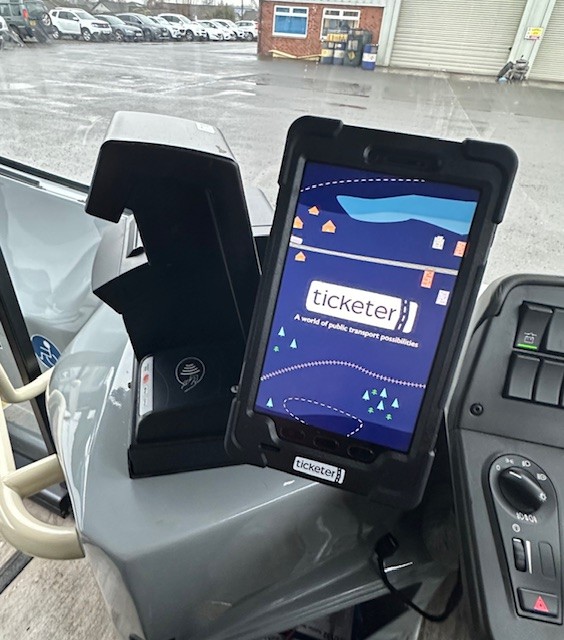 “A really significant achievement is that 50% of our customers’ 23k+ buses have now been upgraded to the Ticketer TK300. Refreshing half of our customer base is enormous — and it matters because it genuinely moves the needle on the passenger, driver and back-office experience.
Q: Ticketer introduced several innovations this year. Which one would you say has made the biggest difference?
“The Ticketer Insights Hub has been the most impactful so far as it gives customers the ability to see what’s happening in real time and make informed decisions.
It’s been completely free to our customers, but what’s more is that we’ve also continually enhanced it with innovative reports such as the latest Schedule Adherence and Punctuality ones becoming absolutely critical for operators.
It’s the cherry on top of our core ticketing technology — the kind of true innovation that changes how our customers run their operations.”
Better Supporting Customers
Q: How has customer feedback shaped that innovation?
“Hugely. A great example is McGill’s Buses in Scotland. They sat with us and told us exactly what the Ticketer Insights Hub needed to do to run effectively. We took that feedback and built it straight into the system.
Because Insights is developed in such an agile way, we can release improvements quickly — and now McGill’s, and indeed all our customers, have reports that do exactly what they require. That kind of open and honest conversation directly shapes not just the Insights Hub, but all our products.”
Q: This year you made several changes internally to better support customers. What has Ticketer done differently?
“A lot. We recognised that serving local or transport authorities, franchise models and commercial operators requires different approaches — so internally, we reassessed how we work, how our people are organised and what skills we need.
As a result, we grew our teams this year and will continue to do so in 2026 to better support our customers. We’ve hired more Customer Success Directors, support specialists, developers, engineers and product managers, because we know supporting customers requires the right people in the right roles.
We’ve additionally invested heavily in efficiency, governance and processes. A simple example is repairs: we’ve implemented the ‘Ticketer Repair Request’ form so customers can more speedily book in a repair collection without having to liaise with the Customer Support team first. We’re also working towards functionality that allows customers to book collections at times that suit them. It’s about giving them “a 21st-century service.”
We also realised we needed to rethink elements of our operation — such as relocating our repair centre from Hungerford to a more central, better-connected site near either Newbury or Reading. The current location makes hiring and logistics difficult; moving will help us increase capacity, improve turnaround times and create a fit-for-purpose, modern space.
Q: What’s been your proudest moment this year?
“To put it simply: turning our customers’ frowns upside down.
It’s been a rocky few years for authorities, operators and by proxy their suppliers, but 2025 has seen stability return, confidence grow and conversations at events shift from worry to progress. That transformation – led by the whole Ticketer team – has been one of the most meaningful outcomes of the year.”
Looking Ahead
Q: 2025 marked another year of growth and stability for Ticketer. Looking ahead to next year, why is long-term sustainability such an important part of your continued strategy?
“One thing I think gets overlooked in the market is the value we’ve placed on sustainable growth for our customers as we too have grown. Ticketer started in 2009, and by 2018 we’d already onboarded the majority of our customer base. We grew incredibly quickly, and since then we’ve focused on scaling in a stable, responsible way.
What’s interesting is that around half of our customers are still running on versions of the original Ticketer hardware they received years ago — supported by countless software enhancements and innovations since. That tells you two things: our tech lasts, and we support what we deliver for the long term.
We also haven’t dramatically increased our cost base. In fact, in some years we didn’t raise prices at all, particularly during high-inflation periods, because we knew the market simply couldn’t absorb it. Where possible, we held prices flat. That’s not something every supplier has been able to do and we will continue to do this when it is possible.
So, when I think about 2025 and the momentum we’re taking into 2026, a big part of that story is stability. We scaled with our customers, we stayed with them, and we’re committed to being a reliable, sustainable partner for the long haul.”
Q: As we move into 2026, what can you divulge about next year’s plans?
 “As part of our Connected Bus strategy, one of the biggest pushes is Driver Connect – we’re piloting it now, and it’s a game changer.
Putting a replacement radio solution directly into the ticket machine means operators can reduce hardware, cut licence costs and give drivers a cleaner, simpler experience. Voice messages, voice calls — everything integrated. It’s a no brainer for our customers, and it improves both driver and passenger experience.
We’re also focusing on deeper partner integrations — with telematics, fleet management systems and more. The goal is simple: the less hardware and friction on the bus, the better the experience for everyone.
And of course, data. Ticketer holds a huge amount of operational data, and we’re focused on making it accessible wherever customers need it — whether that’s in Ticketer systems or their platform of choice. Operators shouldn’t need lots of places to look at their data; things should just join up.
Now, there are plenty more innovations and new offerings in next year’s pipeline that we can’t share just yet.
In recent years, other suppliers have made a habit of using Ticketer as their unofficial roadmap. We’ll take that as flattery, but we’re not slowing down to make it easy for them. And as out customers often tell us, copying a headline feature is one thing, matching the reliability, depth and service behind it is another.
For now, we’re keeping our cards close to our chest. What I can say is that major launches are coming in 2026, and when they arrive, they’ll be unmistakably Ticketer.
Q: And finally, what’s your message to our customers as we move into 2026?
“To every operator, authority and partner we’ve worked with this year – thank you. Your feedback shaped every improvement we made, your collaboration helped us innovate faster and smarter. Your trust enabled us to deliver a more stable, more connected and more customer-centric service.
As we move into next year, we have an ask of you: continue to talk to us, as you have been. We don’t know what we don’t know, and we rely on you all to be honest and direct with us about what you need or if something’s not working. We want that feedback and we want to help – so all you need to do is come and talk with us. “
 Other news and updates